
Arrest Records in Johnston County
An arrest record is created by law enforcement, not by a court. In Johnston County, the Sheriff's Office under Sheriff Steve Bizzell makes and holds most local arrest and booking records. When deputies or local police take a person into custody, the jail books them in. That booking captures a name, a photo, the listed charge, and the date of arrest. City police agencies make arrests too, but people booked into the county jail show up on the sheriff's roster. So the sheriff's data is the best single starting point for recent county bookings.
Arrest records are not the same as criminal court records, and neither one is a conviction record. An arrest record shows that police took someone in and what they were booked on. The court file shows what the State actually charged, what happened at each hearing, and the final outcome. A conviction is only one possible outcome of that court process. For the full case history, including pleas, dispositions, and sentences, use the Johnston County court records page, which walks through the state eCourts Portal. Treat the jail roster as the front door, not the whole house.
How to Search Johnston County Arrest Records
The Johnston County Sheriff's Office posts two public tools. One is the recent-arrest search, which covers the last 15 calendar days. The other is the active inmate inquiry, which lists everyone currently housed in the jail. The recent-arrest search lets you look by name or by a date range, so it is the fastest way to find a fresh booking. Start there at the recent-arrest search page, which offers a name lookup and a date-range lookup side by side.
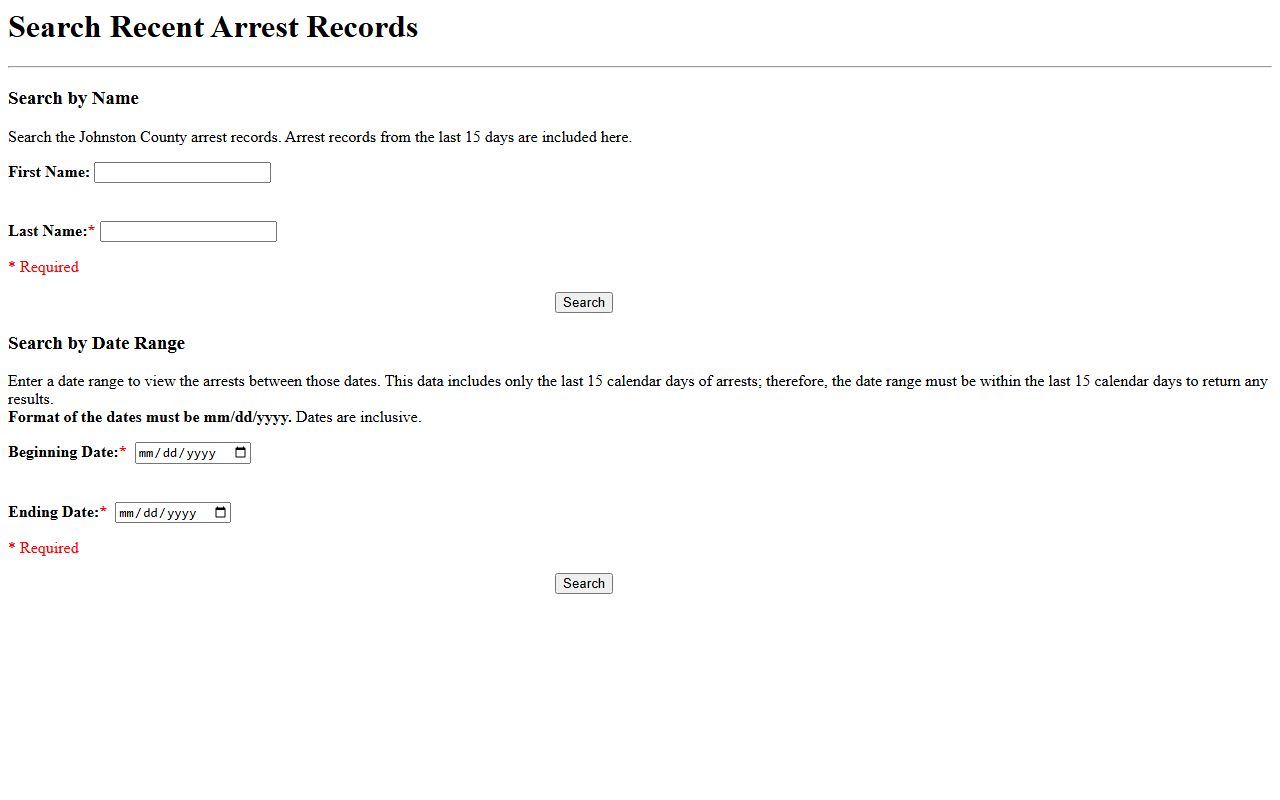
The date-range option only reaches back 15 days, so it works for new arrests, not old ones. For anything older, you switch to the jail roster or the state court portal. Use these steps to run a basic Johnston County arrest records search:
- Open the sheriff's recent-arrest search and pick Search by Name or Search by Date Range.
- For a name search, type the last name. First name is optional but trims the list.
- For a date search, enter a beginning and ending date as mm/dd/yyyy. Both dates count.
- Read the results, then open the jail roster or the eCourts Portal for more detail.
For a current booking, the active inmate inquiry is the better tool. It opens with a disclaimer that you must accept first. The sheriff posts this at the active inmate inquiry page, where you click "I Agree" to reach the live list.
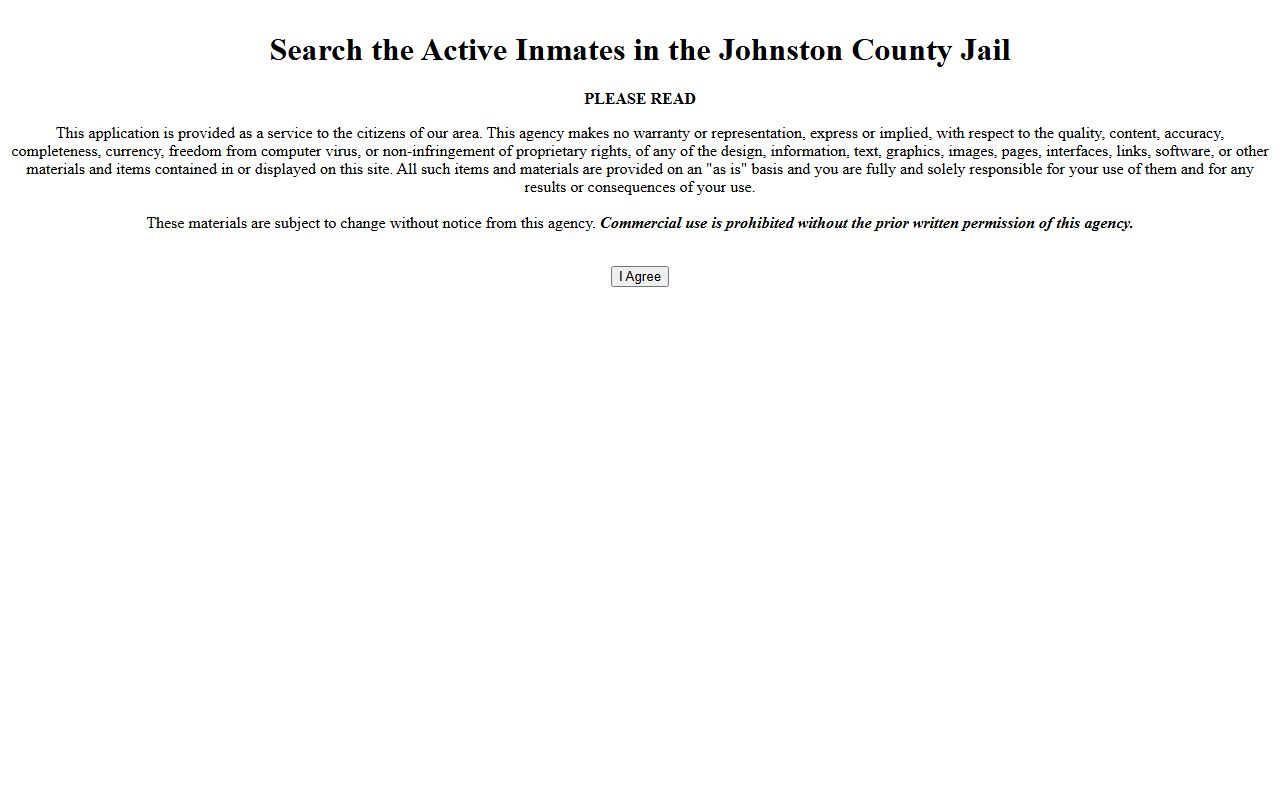
That disclaimer says the data comes "as is" and may change without notice. After you agree, the full custody list loads.
Statewide criminal history is a separate search. North Carolina prison, probation, and parole records sit with the state, not the county jail. If a person served time in state prison or is under state supervision, those records are searchable back to 1972 through the Department of Adult Correction. The county jail roster only shows local custody right now.
Reading the Johnston County Jail Roster
The active inmate list is a custody roster, not a criminal history report. It names the people housed in the Johnston County Jail at the moment the data was last updated. On May 25, 2026, the list showed 297 people currently housed, with a timestamp marking the last update. The roster is plain and short on fields, which is by design. It tells you who is in, not the whole story of why.
The list page shows a sort menu, the person's name as a link, one primary charge, and the arrest date. You can sort by last name, first name, arrest date, or charge description. The state court portal handles the deeper case data. View the live list at the active inmate list page, which loads after you accept the disclaimer.
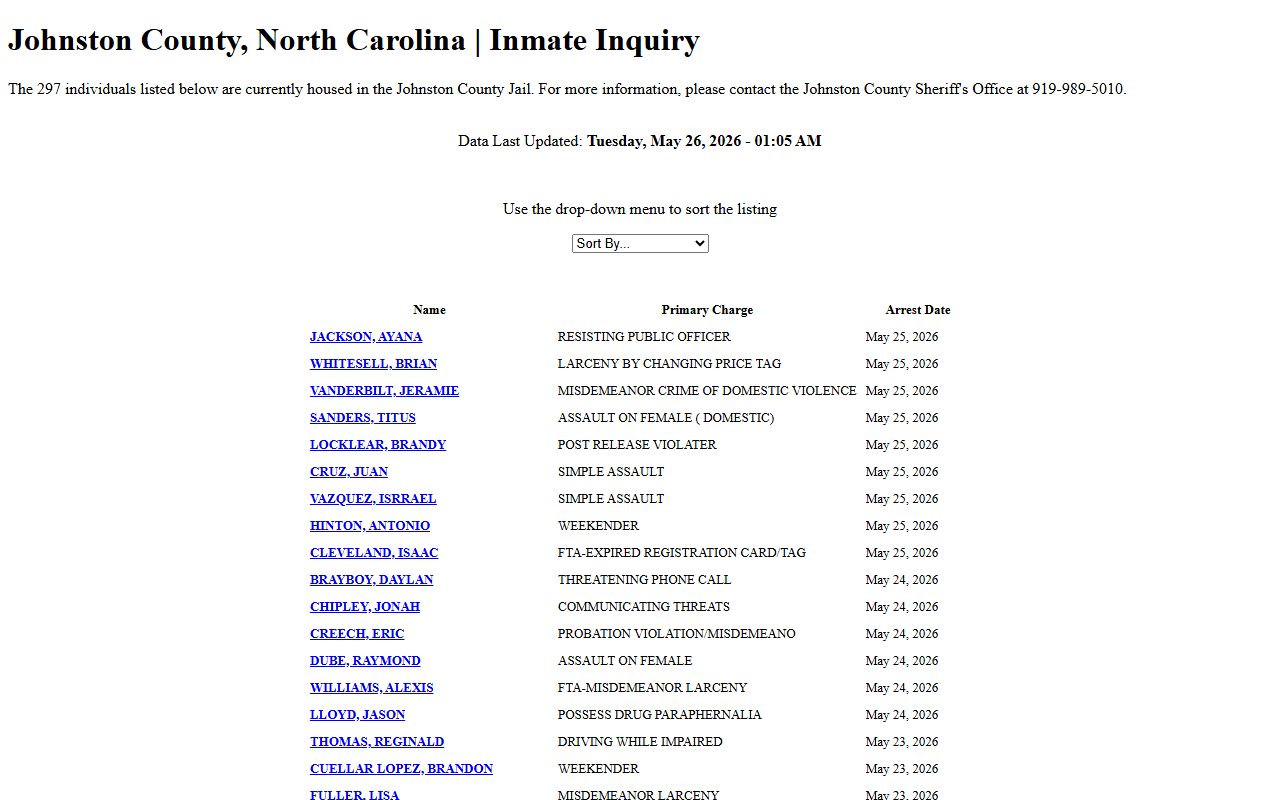
Each name links to a short profile with a booking photo. The fields below show the recent-arrest search options, which mirror how the roster is queried.
| Field | Type | Required | Notes |
|---|---|---|---|
| Search by Name | Section | Optional | Searches recent arrest records by name. |
| First Name | Text | No | Optional, narrows the result list. |
| Last Name | Text | Yes | Required, marked with a red asterisk. |
| Search by Date Range | Section | Optional | Covers the last 15 calendar days only. |
| Beginning Date | Date | Yes | Format mm/dd/yyyy, inclusive. |
| Ending Date | Date | Yes | Format mm/dd/yyyy, inclusive. |
The "Primary Charge" column lists just one charge. A person may face more charges, warrants, or holds than the roster shows. To find someone currently held, the Johnston County inmate records page covers the roster in full, plus visitation and money deposits.
Note: the roster reflects only who is housed at the last update time, so a recent release or transfer can drop a name even when an arrest record still exists.
What a Johnston County Booking Profile Shows
Click a name on the roster and a profile opens. It is brief. The profile shows a small set of identity fields, a booking photo, and a short charge table. It leaves out a lot of detail that people expect, like bond and court dates. Those live with the magistrate, the clerk, or the court portal, not the jail page. The table below lists the fields a typical profile shows and flags what it does not.
| Field | What It Shows |
|---|---|
| Name | Full last and first name of the person held |
| Age | Numeric age at booking |
| Race | One-letter code, such as B |
| Sex | One-letter code, such as F |
| Booking Date | Month, day, and year of booking |
| Inmate Photo | Booking photo, a small image of the person |
| Charges Table | Each charge with its arrest date |
| Not Shown | No booking number, DOB, bond, housing pod, magistrate, warrant number, court date, or release date |
So the profile answers who and what, but not how much bond or when the next court date is. For bond, release conditions, and court dates, you call the jail, call the clerk, or check the eCourts Portal. The charge table also skips statute citations and case numbers, which is one more reason to pair an arrest record with the court file.
Arrest Records vs. Criminal Court Records
An arrest happens at booking. A criminal court record starts when the State files charges and a case opens in court. They come from different offices and hold different things. The sheriff makes the arrest record. The Clerk of Superior Court keeps the court file. Many people only need one of the two, so it helps to know which is which before you search.
| Arrest Record | Criminal Court Record | |
|---|---|---|
| Source | Sheriff or police | Clerk of Superior Court |
| Created When | Booking into jail | Charges filed in court |
| Contents | Booking info, listed charge, photo | Pleadings, motions, disposition, sentence |
| Where to Find | Sheriff's jail roster | eCourts Portal |
Use the arrest record to confirm a booking and a custody status. Use the court file to learn what was charged, what was dropped, and how it ended. Pairing them gives the full picture.
Charges vs. Convictions
A charge is an accusation. A conviction is a finding of guilt. They are not the same, and one does not always lead to the other. Prosecutors can amend, dismiss, upgrade, or supersede charges as a case moves through court. The charge label on the jail roster is a starting point, not the final filed charge or the final outcome. Always check the court file for what really happened.
| Charge | Conviction | |
|---|---|---|
| Stage | Accusation at or after arrest | Verdict or guilty plea |
| Burden of Proof | Probable cause | Beyond a reasonable doubt |
| Can It Change | Yes, often | Final unless appealed |
| Public Record | Yes | Yes |
Because charges shift, do not read a roster entry as a verdict. The District Attorney decides what to pursue, and the court decides the result. For impaired-driving and other traffic-linked charges, the Johnston County traffic court records page explains how those cases route through the courts.
Sealed vs. Expunged Criminal Records
North Carolina lets some people clear eligible records. Sealing hides a record from ordinary public view. Expunction goes further and removes the record so it is treated as if it never existed in public files. The two are often confused. Expunction in this state is statute-driven and granted by a court. It is not automatic, and not every offense qualifies.
| Sealed | Expunged | |
|---|---|---|
| Visibility | Hidden from public view | Removed; treated as never existed |
| Law Enforcement | Limited access | Confidential files kept for narrow uses |
| How It Happens | Court order or statute | Petition granted by the court |
| Eligibility | Set by court rule or statute | Certain misdemeanors and nonviolent felonies after waiting periods |
The main adult expunction laws are G.S. 15A-145 for certain misdemeanor convictions and G.S. 15A-145.5 for certain nonviolent misdemeanors and felonies after a waiting period. After an expunction, confidential agency files may remain under G.S. 15A-151 for limited statutory purposes. Expunction is filed in the county court using the correct AOC form, and some types need district attorney review. Talk to the clerk, legal aid, or an attorney before you act.
Mugshots and Booking Photos
A booking photo, often called a mugshot, is taken when a person is processed into the jail. In Johnston County, the active inmate profile includes a small booking photo of the person currently held. It loads from the sheriff's arrest data. When a person is released, that profile drops off the active list, so the photo is no longer on the public roster.
Booking information can be public under North Carolina law, but investigative details are different. G.S. 132-1.4 treats records of criminal investigations and intelligence as not public, even though some arrest and incident information may be released. So a mugshot tied to a current booking can show, while the case file behind it may hold material that is not open. The jail page does not keep a searchable archive of old mugshots once someone leaves custody.
Statewide Criminal Records Search
County jail data only covers local custody. For state prison, probation, and parole history, the North Carolina Department of Adult Correction keeps records that reach back to 1972. Its offender search hub and offender locator let you look up people in or released from state custody. This is the right tool when a person is not on the county roster but has a state record. Start at the NC Department of Adult Correction offender searches page, which links the public locator.
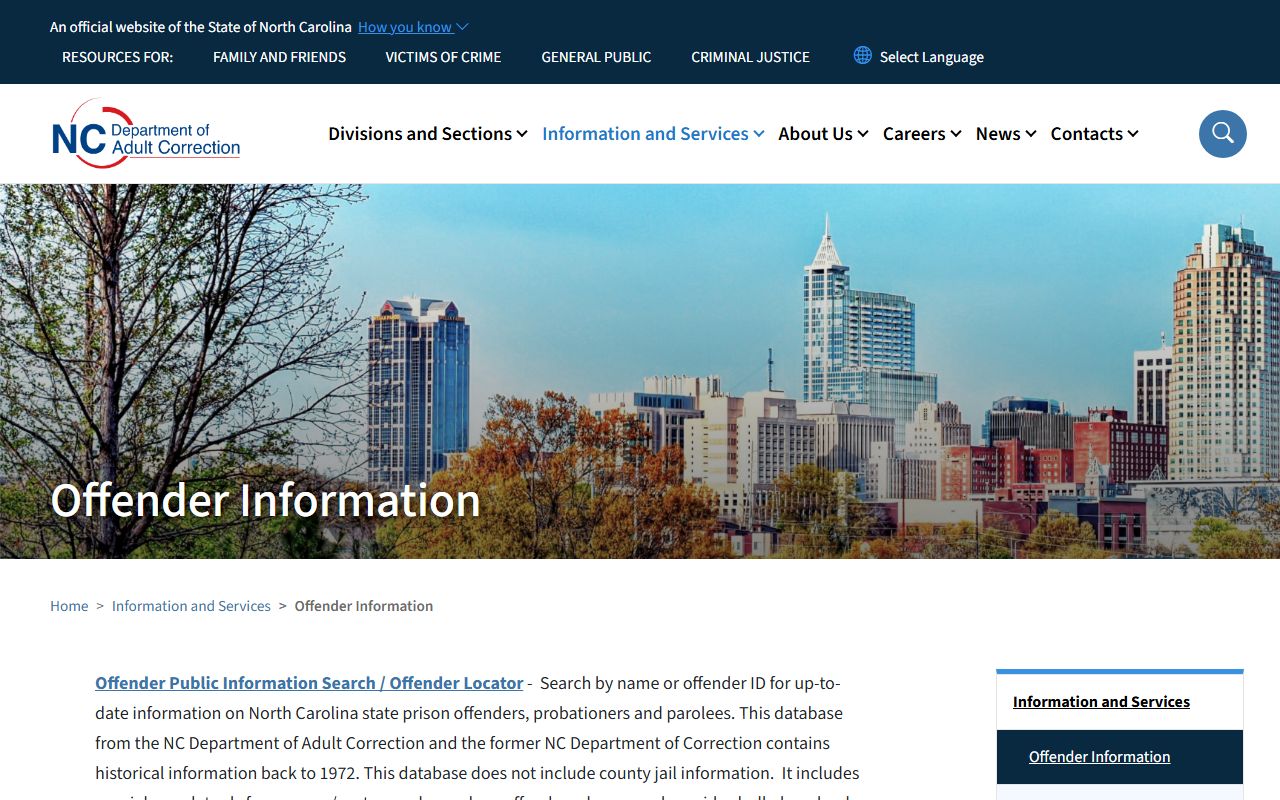
That hub points to the public offender locator, where you search by name. For a certified criminal record limited to one county, the path is different. You request a certified single-county criminal record search through the clerk using Form AOC-CR-314, which costs $25. Public self-service terminals at the clerk's office let you look up cases for free, but those results are not certified. For a background check, go through the clerk, not the public web portal.
Background Check Considerations
A casual name lookup and a formal background check are not the same thing. The free public terminals and the eCourts Portal can show case data, but they are not certified and are not built for hiring or housing decisions. A real background check that follows federal rules has to come from a proper source and respect the limits set by law. For criminal records in one county, the certified search through the clerk is the official route.
Important: This site is not a consumer reporting agency under the FCRA, and its information cannot be used for credit, employment, tenant, or insurance decisions.
Restricted Criminal Records in Johnston County
Not every record tied to an arrest is open to the public. North Carolina walls off several categories. Juvenile court files fall under Chapter 7B and are not ordinary public records; G.S. 7B-3000 governs juvenile court records and limits access to parties, attorneys, and authorized agencies. Expunged matters drop out of public access by court order. Sealed records stay hidden unless a court unseals them.
Active investigation files are also held back. Under G.S. 132-1.4, investigative notes, witness statements, informant details, lab work, and intelligence may be withheld even when basic arrest information is released. Unreturned criminal warrants and protective orders are flagged in the state portal as records needing elevated access. The Johnston County warrant records page explains why a full online warrant list is not public. Do not assume a missing online record means no arrest or case exists, since timing, sealing, and spelling all affect what shows up.
Jail, Prosecutor, and Defender Contacts
The Johnston County Jail sits at 127 S. Second Street in Smithfield. The Sheriff's Office handles bookings and custody, and its jail FAQ page answers common questions about visits, attorneys, and court dates. The Johnston County Jail page lists the Sheriff's Office contact block and general jail lines.
That page gives the jail's general information line and mailing details. For attorney and case questions, the sheriff's FAQ points callers to the jail or the clerk.
The jail FAQ page covers how to reach an inmate, how to ask about court dates, and who to call about charges.
The FAQ says to call the jail at 919-989-5040 or the Clerk's Office at 919-209-5400 for attorney information, and to contact the District Attorney about dropping charges. Two offices shape what happens after an arrest. The District Attorney, Jason T. Waller of Prosecutorial District 13, prosecutes criminal cases and can reach the office at (919) 209-5520. The Public Defender, A. Traynham Dorn of Defender District 13, represents eligible people who cannot afford counsel and has served since July 1, 2024. An arrest does not decide either prosecution or defense; the court process does.