
How to Look Up Johnston County Jail Population Data
The clearest source for the current Johnston County jail population is the Sheriff's Office active inmate list. It lives on the county website and lists every person housed in the jail at the time the page was last refreshed. To reach it you accept a short disclaimer, then the list loads. The page also prints a "Data Last Updated" timestamp at the top. On May 25, 2026 at 11:05 PM, that page reported 297 individuals housed in the Johnston County Jail. This number is county-specific and comes straight from the Sheriff's own roster.
The count is not fixed. Snapshots taken across that same week showed totals from about 288 to 311, depending on the timestamp. So the figure you see is a point-in-time read, refreshed often, not a settled monthly or yearly average. The list itself is plain. It shows each person's name, one primary charge, and an arrest date, and it can sort by last name, first name, arrest date, or charge description. It does not roll those entries into totals or percentages.
For aggregate, multi-year, or demographic figures, no official county dashboard was located. When a number is missing at the county level, the honest move is to say so and turn to state and national data for context. The Bureau of Justice Statistics is the main federal source for jail population data, and it is covered further down.
Note: the active list is a live custody snapshot, so two people checking it hours apart can see different totals on the same day.
Johnston County Jail Capacity Overview
Jail capacity is the number of beds a facility is built and rated to hold. For Johnston County, a current official capacity figure was not found in present-day Sheriff or county sources. That gap matters, because without a current rated capacity you cannot compute a true occupancy rate against the live count. The only capacity figure in the record is old. County Board minutes from April 12, 2005 quote Sheriff Bizzell saying the jail was designed for 191 inmates and was averaging about 215 at that time. That is a dated historical note from 2005, not a current capacity number, and it should not be read as today's rated beds.
The jail sits at 127 S. Second Street in Smithfield. The table below pairs the facility with the data the county actually publishes. Where a current number is not published, the table says so plainly rather than guessing.
| Facility | Rated Capacity | Current Population (snapshot) |
|---|---|---|
| Johnston County Jail, 127 S. Second Street, Smithfield | Not published in current sources (2005 board minutes cited a 191 design figure, now dated) | 297 on May 25, 2026 at 11:05 PM (county active list) |
Because the rated number is unverified, treat the 297 figure as a raw head count, not as a share of capacity. To confirm current capacity, call the jail at 919-989-5040 or check adopted county budget and detention facility documents.
Average Daily Population
Average daily population, often shortened to ADP, is the mean number of people held over a full year. It smooths out the daily swings that the live roster shows. ADP is the figure jails use for budgeting, staffing, and trend reports, because one busy night or one slow weekend does not move it much.
No official Johnston County ADP table was located in current sources. The county does not appear to publish an annual jail report with a year-by-year ADP line. What is available is the live active-list count, which is a daily snapshot and not an average. Counting 297 on one night does not equal an ADP of 297. For a true average you would need many days of counts across the year, which the county does not post in one place. Researchers who need an ADP-style figure for Johnston County should request it from the Sheriff's Office or look to state and national jail data, covered below, for comparable rates.
Demographic Breakdown
A demographic breakdown splits the jail population by gender, race, and age. Many large jail systems publish these totals. Johnston County does not. The public active inmate list shows only a name, one primary charge, and an arrest date. It does not publish gender totals, race totals, or age totals for the population as a whole.
An individual inmate profile does show a few personal fields. A profile page can list the person's age, a one-letter race code, and a one-letter sex code, along with a booking date and a charges table. But those fields sit on one person's page. The county does not add them up into a population-wide demographic table, so there is no official county percentage to report here. The table below is honest about that: it shows what the public record holds at the person level versus what it does not publish in aggregate.
| Data Point | Published by Johnston County? |
|---|---|
| Name, primary charge, arrest date (active list) | Yes, per person |
| Age, race code, sex code, booking date (profile) | Yes, per person |
| Population-wide gender breakdown | No |
| Population-wide race breakdown | No |
| Population-wide age breakdown | No |
The Sheriff's profile page is where those per-person fields appear, and it is a useful look at what the public record actually shows.
A sample Johnston County inmate profile page displays name, age, race, sex, booking date, and a charge list.
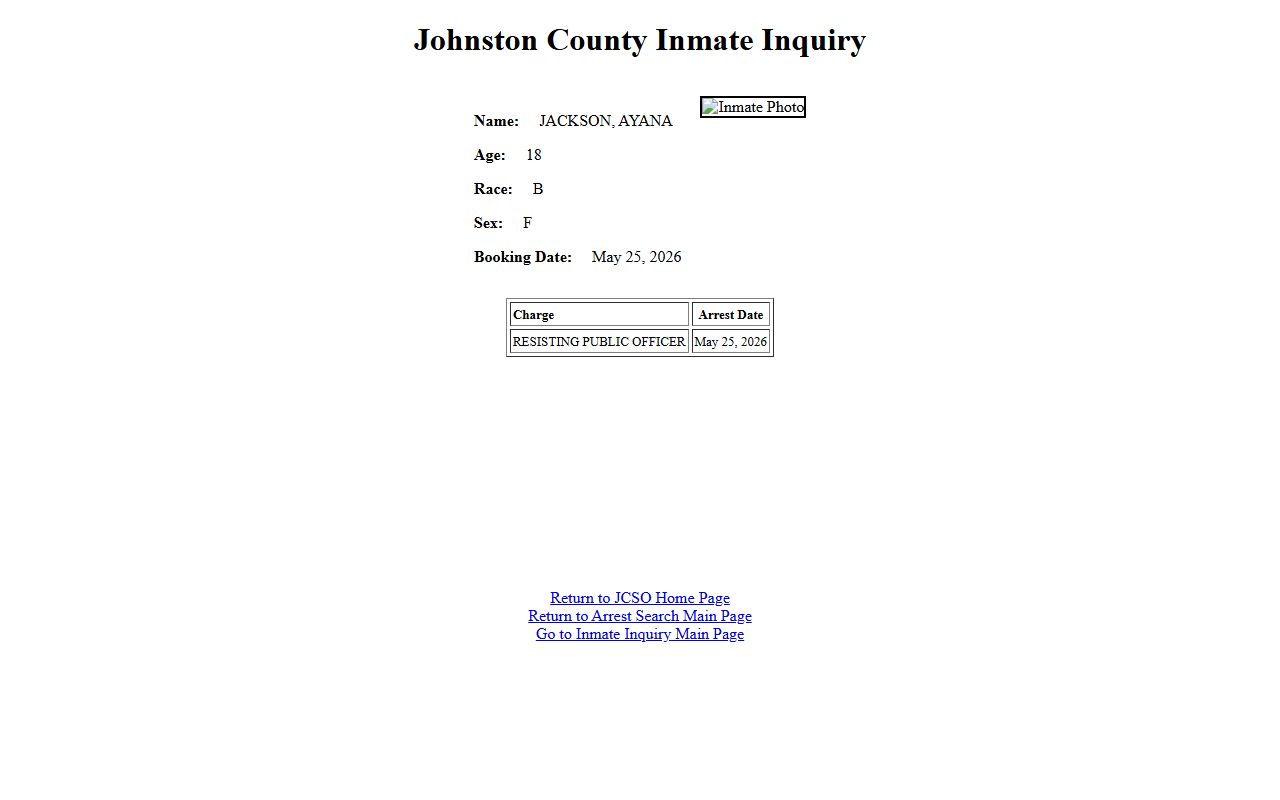
That page proves the fields exist for one person, but it also shows why no county-wide demographic table can be built from the public list alone.
Pretrial vs. Sentenced Population
Jails hold two broad groups. Pretrial detainees are people waiting for their cases to resolve, often because they have not posted bond. Sentenced inmates are serving a term after conviction, usually a misdemeanor sentence or a short felony sentence served locally. The split between the two is a key measure, because a large pretrial share points to bond and case-processing pressures rather than to people serving time.
Johnston County does not publish this split. The active inmate list shows a charge and an arrest date, but it does not flag whether a person is pretrial or sentenced. The table below marks that clearly so no false number gets read into it.
| Status | Percent (Johnston County) |
|---|---|
| Pretrial | Not published |
| Sentenced | Not published |
For national context on this split, the Bureau of Justice Statistics reports that the majority of people held in local jails across the country are unconvicted, meaning pretrial. That is a national pattern, not a Johnston County figure, and it is labeled as such in the context section below.
Misdemeanor vs. Felony Population
A charge level tells you how serious an offense is. Misdemeanors are lower-level offenses. Felonies are the more serious ones. People often want to know how the jail population splits between the two, since felony holds and misdemeanor holds move through the court system at very different speeds.
Johnston County does not publish a misdemeanor-versus-felony total for its jail population. The active list shows a single primary charge per person. You can sort that list by charge description, and doing so groups similar offense labels together, such as FTA, DWI, probation violation, assault, or larceny. That sorting reveals categories, but it is not a formal statistical distribution. One person can have charges that are not shown, and the listed primary charge is only a short label, not the final filed charge or the disposition. So a count built by hand from the sorted list would be an estimate at best, and the county does not stand behind it as a statistic. For the charge level that controls a case, the court file is the source, not the roster label.
Mental Health and Medical Population
Many jails track how many people in custody receive mental health or medical care. These figures help measure the load on jail health services. Johnston County does not publish them. The active inmate list and the profile pages do not show any medical or mental-health status, and county sources state that medical and mental-health information is confidential.
The jail does run a medical line at 919-989-5035 for questions about an inmate's medication and care, but that is a contact channel, not a public data feed. So there is no county number to report for the share of the population in mental health or medical programs. For the broad national picture, the Bureau of Justice Statistics has published reports on the high rate of mental health conditions among jail inmates nationwide. That is national research, clearly not a Johnston County count, and the next section points to where to find it.
National and State Context
When county numbers are thin, state and national data give a frame of reference. The Bureau of Justice Statistics is the federal agency that collects and reports jail and prison population data for the whole country. Its national jail reports cover the total jail population, the pretrial share, race and gender breakdowns, and the incarceration rate per 100,000 residents. Those are national figures. They are not Johnston County figures, and they should be read as a backdrop, not as a local count.
At the state level, the North Carolina Department of Adult Correction holds data on the state prison population, which is a separate system from county jails. The Prison Policy Initiative publishes state-level incarceration context for North Carolina that can help compare the state against the nation. The comparison block below shows why a clean three-way rate table cannot be built for Johnston County: the county simply does not publish a per-100,000 jail rate.
| Level | Jail Population Rate per 100k | Source |
|---|---|---|
| Johnston County | Not published (live count only, 297 on May 25, 2026) | County Sheriff active list |
| North Carolina (state) | See state reports (state-level context) | Prison Policy Initiative / NC DAC |
| National | See current BJS jail report | Bureau of Justice Statistics |
State prison data is a different file from the county jail roster, and the state correction agency is where that lives.
The North Carolina Department of Adult Correction publishes state prison population data and offender search tools.
That state agency covers prison, probation, and parole counts, which sit above and apart from the daily jail numbers a county sheriff posts.
Population Trends Over Time
A population trend tracks how the count changes across months and years. A multi-year line can show whether a jail is filling up or easing off. For Johnston County, no official five-year jail-population report, annual jail report, or trend table was located in current sources. So a real local trend line cannot be drawn from official data here.
What the record holds is two separated points, and they are not directly comparable. The 2005 board minutes cited a roughly 215 daily average against a 191 design figure. The 2026 active list showed 297 on one night. Those come from different years, different methods, and different purposes, so the jump from one to the other is not a clean trend. The only reliable ongoing signal the county gives the public is the live count, which swings day to day, as the 288 to 311 range that week showed. For a genuine multi-year trend, a records request to the Sheriff's Office or county budget office would be the route, and national series from the Bureau of Justice Statistics offer a long-run frame for how jail populations have moved across the country.
Searching for Johnston County Inmate Records by Name
This page covers aggregate jail population data, not individual lookups. To find one person by name, use the live jail roster on the Johnston County inmate records page, which walks through the Sheriff's active inmate search and what each profile shows. For people no longer in custody, the released inmates page explains how to confirm a release, and the arrest records page covers recent bookings.
Where the Data Comes From
The live Johnston County count comes from one place: the Sheriff's Office active inmate list, refreshed often and stamped with an update time. That is the only official, current, county-specific population figure. The Sheriff makes no warranty about it and labels the data as is, so it should be treated as a working snapshot. County budget context, like the FY 2025-2026 budget that cut the property tax rate to 52 cents per $100, sits on the county budget page, but a jail-specific operating budget or cost-per-inmate figure was not extracted from it.
Beyond the county, national jail data comes from the Bureau of Justice Statistics, and state-level context comes from the Prison Policy Initiative and the North Carolina Department of Adult Correction. Two outside tools round out research. One is a free legal-research site, and the other is a civil legal-aid group, and both are described honestly below as non-official.
Federal case records are a separate world from county jail counts, and one well-known free tool helps people find them.
CourtListener is a free legal-research site that hosts many federal opinions and dockets, but it is not the official federal docket and it does not carry county jail population data.
Use it for federal opinions and case history, not for jail head counts, and always confirm anything important against the official court source.
Population data also connects to reentry, since people leaving the jail often need civil legal help.
Legal Aid of North Carolina offers free civil legal help, including expunction, housing, and benefits work where a person qualifies.

That group is a useful pointer for the reentry side of the population picture, though it is a nonprofit and not a government records office.