
North Carolina Public Records Law and Johnston County Public Records
The state's public-records law begins in Chapter 132 of the General Statutes. It defines a public record very broadly, covering documents and other material made or received by a government agency in connection with public business, no matter the physical form. The law starts from a clear idea. Public records belong to the people, and the people may see them.
Two core sections do most of the work. G.S. 132-1 sets the definition and says records are the property of the public. G.S. 132-6 gives any person the right to inspect and copy records at reasonable times, and it bars an office from forcing you to state why you want them. That same section lets an agency meet its duty by posting records online in a view, print, or save format. You can read the full set in Chapter 132.
So who can ask? Anyone. You do not need to live in the county or the state. You do not need a lawyer. You do not have to give a reason. That open standard is the heart of how Johnston County public records work day to day.
Court Records Versus State Administrative Records
This split trips up a lot of requesters, so it is worth getting right. Court case files are kept by the local Clerk of Superior Court in the county where the case was filed. They are not held by the state court office. The North Carolina Administrative Office of the Courts, or NCAOC, keeps its own administrative records, which are a different thing entirely.
NCAOC runs a public-record request form, but it is only for existing Judicial Branch administrative records. The form page warns plainly that NCAOC is not the custodian of court documents, case information, marriage or birth certificates, or background searches. So if you want a Johnston County case file, you go to the clerk, not to NCAOC. Under its own policy, NCAOC does not charge for inspection and charges $0.25 per page for copies. For a Johnston County court file, the request runs through the clerk instead.
For full case detail and the eCourts Portal walkthrough, see the Johnston County court records page. Certified court copies and search forms come from the clerk's office, covered on the Clerk of Superior Court page.
What the Register of Deeds Maintains
The Johnston County Register of Deeds is the custodian for a large share of the county's public records. Craig Olive serves as Register of Deeds. The office records legal documents and maps, issues marriage licenses, certifies documents, and keeps vital records. It sits on the first floor of the courthouse. Many people looking for Johnston County public records actually need this office, not the court clerk.
Here is what the Register of Deeds holds and the rough start dates for the public index:
- Deeds and land records - recorded and indexed from 01/03/1989, with older items in the Historical Index.
- Plats, condos, and highway right-of-way maps - all records indexed.
- Marriage records - indexed from 01/01/1942, plus current marriage licenses.
- Birth and death records - all records indexed, including delayed births.
- UCCs and powers of attorney - financing statements and other recorded instruments.
The Register of Deeds homepage lays out the services, address, hours, and the name of the Register. You can start at the Johnston County Register of Deeds homepage for an overview.
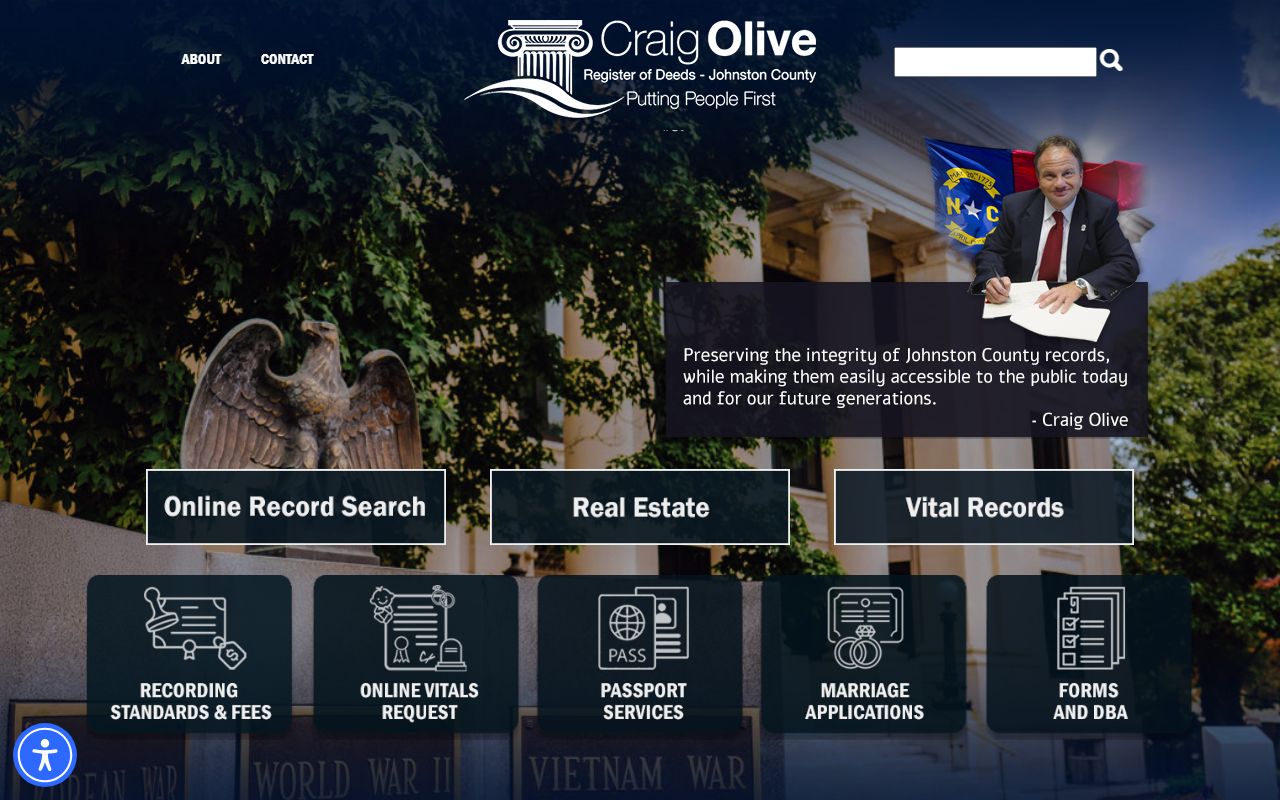
That page shows the office on Courthouse Square and lists the main and vital-records phone lines. Marriage records, in particular, are explained in more depth on the marriage and divorce records page.
Searching Johnston County Public Records Online
The Register of Deeds offers a public EagleWeb search through its online record search page. Guest users do not need an account. You first accept a disclaimer by clicking a button labeled "I Acknowledge," and the site needs cookies and JavaScript turned on. Document images download as PDF files, so you need a PDF reader to open them. This free tool covers a deep slice of Johnston County public records.
The online record search landing page links straight into the public EagleWeb system. You can reach it from the Register of Deeds online record search page.
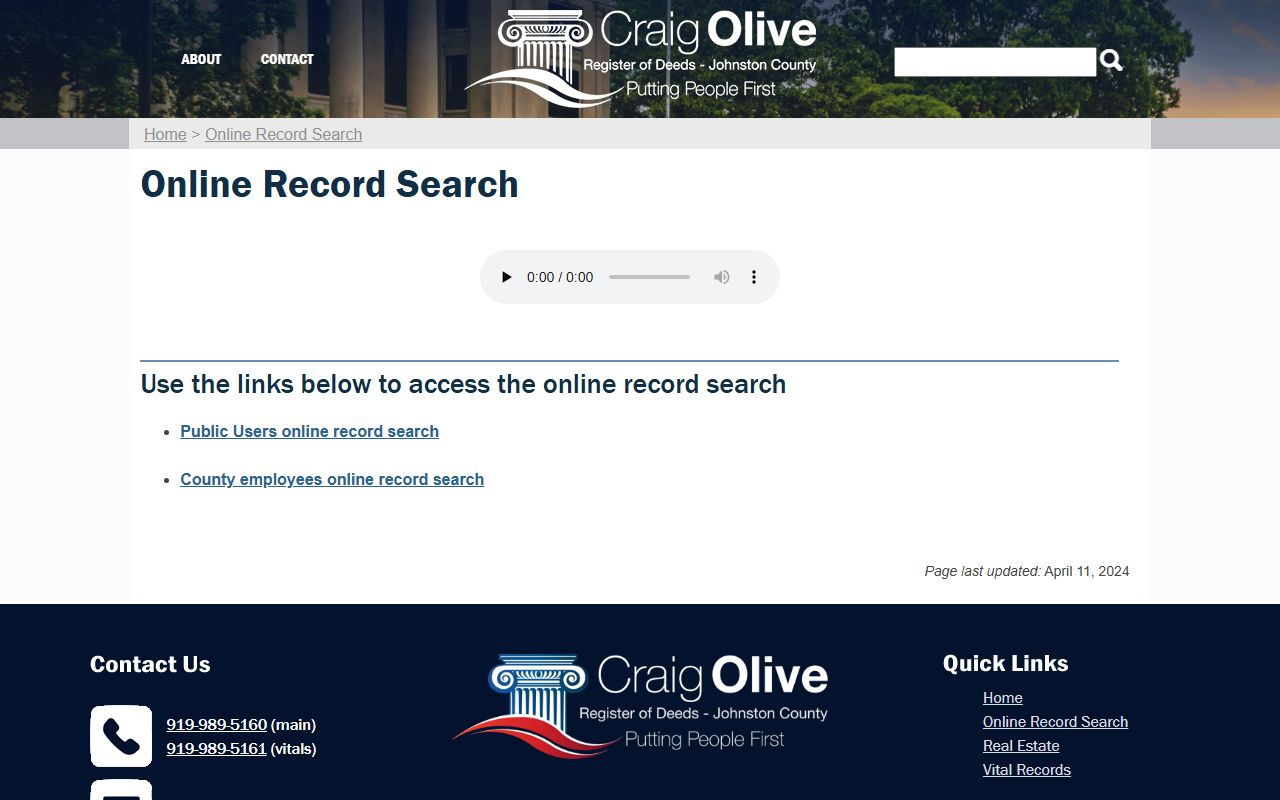
Once inside, the land search is rich. You can search by grantor or grantee name, recording date, book and page, document number, legal remarks, subdivision, township, and parcel ID. Township options include Smithfield, Clayton, Selma, Cleveland, and Pleasant Grove, among others. The disclaimer advises searching all spelling variations of a name to catch every match, and it notes that under G.S. 106-741 the county maintains land records flagging parcels near qualifying farms or voluntary agricultural districts.
How to File a Public Records Request in Johnston County
A request does not have to be fancy. The law lets you ask in plain terms, and the office must respond as promptly as possible. The main work on your end is aiming the request at the right custodian and saying clearly what you want. Vague requests slow things down. Specific ones move fast.
- Find the right office. Court files go to the Clerk of Superior Court. Deeds, plats, marriage, birth, and death records go to the Register of Deeds. Arrest or incident information goes to the Sheriff's Office. NCAOC administrative records go to the state court office.
- Describe the records clearly. Give names, a date range, a book and page, a parcel ID, or a case number when you have one. The more detail, the better the match.
- Submit the request. Search the free EagleWeb tool yourself, email rodinfo@johnstonnc.gov, call the office, mail a letter, or visit in person during business hours.
- Wait for the response. The custodian inspects, gathers, and may redact protected material before release. Records that do not exist cannot be created on demand.
- Pay any copy fee and receive the records. Inspection is generally free. Copies and certifications carry a charge, which is covered below.
Note: an office is not required to create or compile a record that does not already exist, so frame your request around records the office actually keeps.
Public Records Request Form Fields
For Judicial Branch administrative records, NCAOC uses a standard request form. It collects basic contact details in Section A and the description of the records in Section B. Remember that this form is for administrative records only, not for Johnston County court case files, which go to the clerk. The table below lists the fields on the NCAOC form.
| Field | Required | Notes |
|---|---|---|
| Name of Requesting Individual | Yes | Section A contact details. |
| Title within Firm or Organization | No | Optional, if you represent a firm. |
| Phone Number | Yes | Best daytime number. |
| Email Address | Yes | Used for the agency reply. |
| Mailing Street Address 1 | Yes | Primary mailing line. |
| Mailing Street Address 2 | No | Suite or unit if needed. |
| City | Yes | Section A. |
| State | Yes | State dropdown. |
| ZIP Code | Yes | Section A. |
| Records Requested | Yes | Section B; existing records only. |
Response Timelines and Redactions for Johnston County Public Records
North Carolina does not set a fixed day count in Chapter 132. Instead, G.S. 132-6 tells custodians to permit inspection and furnish copies as promptly as possible. Simple requests can be same-day. Larger or older ones take longer, since staff may need to pull paper files or run a wider search.
Redaction is common and lawful. The statute says an office cannot refuse a whole record just because some confidential information is mixed in with public information. The fix is to release the public parts and black out the protected parts, like a Social Security number or a sealed item. So a record may come back with sections hidden rather than withheld in full. If a request is denied outright, the office should explain the basis for the denial.
Johnston County Public Records Fees
Inspection is generally free under the open-records law. Copies and certified documents carry a charge. Under G.S. 132-6.2, ordinary uncertified copy fees are limited to the actual cost of making the copy, unless another law sets a different rate. An office may add a special service charge when a request needs extensive IT, clerical, or supervisory help. The table below shows common Johnston County public records costs drawn from official sources.
| Item | Amount |
|---|---|
| Record inspection | No charge |
| NCAOC administrative copy, per page | $0.25 |
| Marriage license (Register of Deeds) | $60.00 |
| Certified single-county criminal record search (Form AOC-CR-314) | $25.00 |
| Uncertified copies | Actual cost |
| Special service charge | Cost of extensive IT or clerical help |
The marriage license fee and accepted payment methods appear on the Register of Deeds marriage page. You can confirm the current charge on the Register of Deeds marriage page.
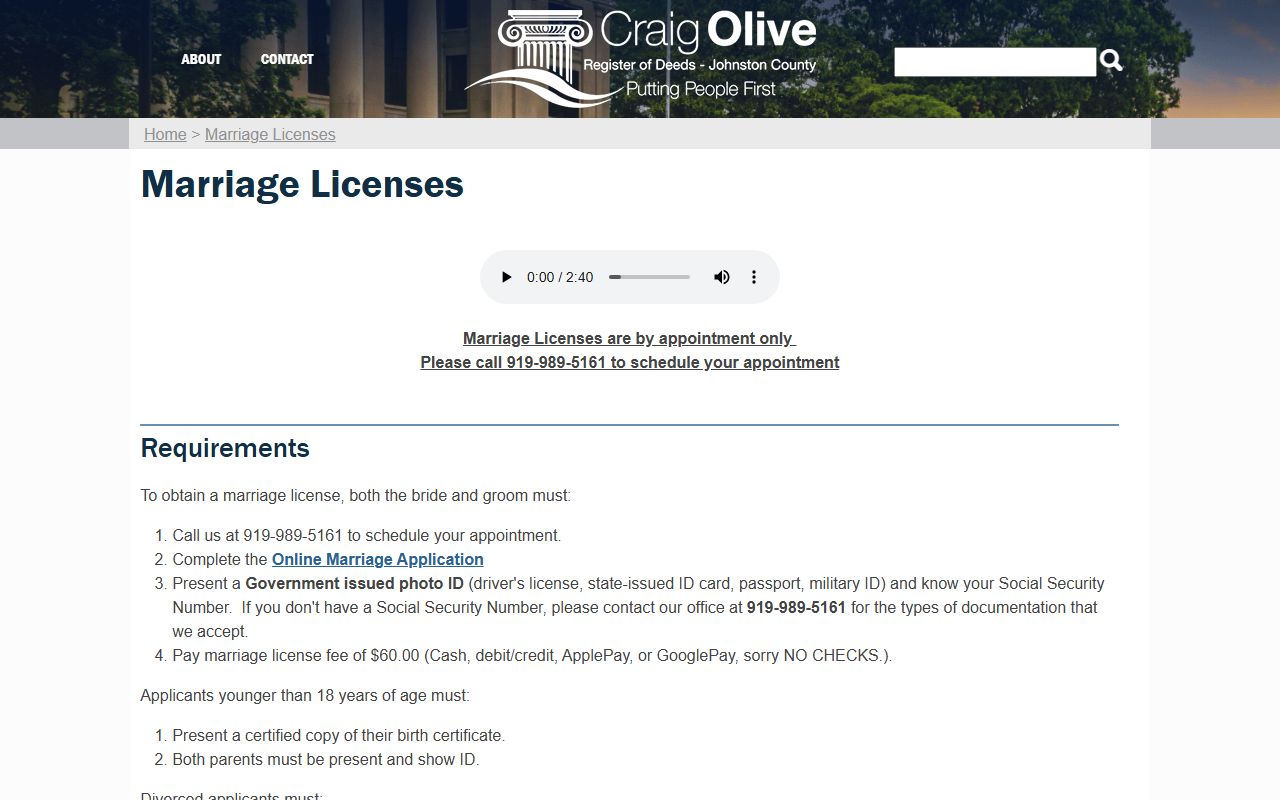
That page lists the marriage license requirements and the accepted payment methods, which include cash and cards but not personal checks. EagleWeb copy and certification fees are set by the office, so confirm the current rate before you order a large batch.
Records That Are Exempt From Johnston County Public Records
The open-records right is broad, but it is not total. Several categories sit outside it. The biggest one for many requesters is criminal investigation material. Under G.S. 132-1.4, records of criminal investigations and criminal intelligence information are not public records. The same statute still treats certain arrest and incident information as public, so a basic blotter entry can be open even when the full investigative file is closed.
The Sheriff's Office handles that line in Johnston County. Sheriff Steve Bizzell leads the office, and arrest or incident information may be released while active investigation files stay restricted. You can reach the office through the Sheriff's Office page.
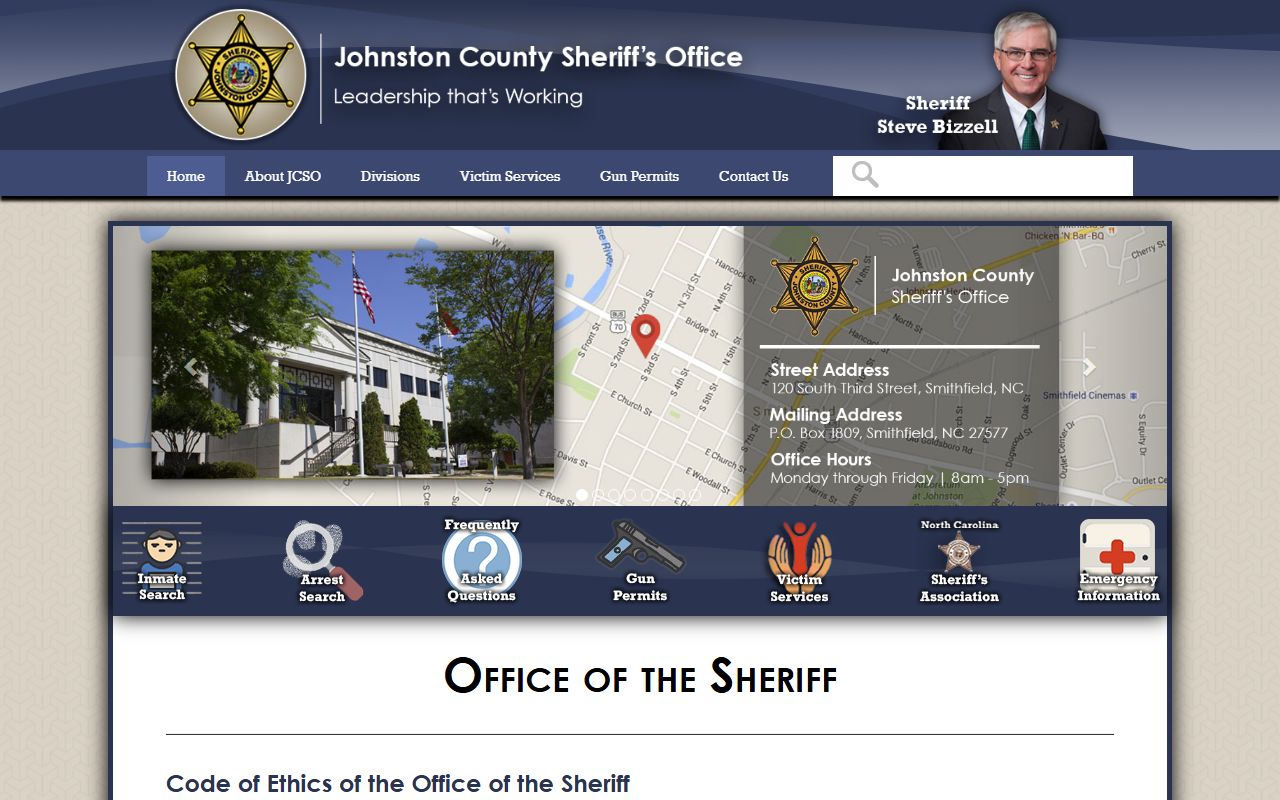
That page lists the office address and phone line for record questions. Other exempt categories come from court-related law, not Chapter 132. Juvenile court files, adoption records, mental health and commitment records, and sealed or expunged matters all fall outside ordinary public access. For arrest and incident detail, see the Johnston County criminal records page, and for estate confidentiality rules see the probate records page.
If Your Johnston County Public Records Request Is Denied
A denial is not the end of the road. North Carolina gives requesters a path short of court. For fee disputes, G.S. 132-6.2 lets the State Chief Information Officer or a designee mediate an unfair or unreasonable charge. That is a quick way to challenge a copy bill that looks too high.
For records held by the Judicial Branch, NCAOC offers pre-litigation mediation. A person who believes a record was unjustly withheld may request mediation by completing and filing Form AOC-CV-830 with the proper court. Mediation aims to settle the dispute before anyone files suit. If mediation fails, a requester can still seek relief in court. Keep copies of your request and any reply, since a clear paper trail helps if you need to push further.