
How to Search Johnston County Court Records
Court cases in Johnston County are searched through the North Carolina eCourts Portal at portal-nc.tylertech.cloud/Portal/. The portal lets you look up case records, find hearing dates, and pay many fines and fees. North Carolina finished moving all 100 counties onto the Enterprise Justice (Odyssey) system by October 13, 2025, so Johnston County cases live in the same statewide search. You do not need an account to view public case information. Frequent users can register to save cases.
Before you start, gather what you know. A full name helps. A case number helps more. North Carolina case numbers have four parts: a two-digit year, case-type letters, a six-digit sequence, and a three-digit county code, like 21CR000003-910. If you only know part of it, the portal allows wildcard searches.
The Judicial Branch county landing page is a good first stop for district numbers, calendars, and payment links.
The Johnston County page on the state Judicial Branch site gathers court services, calendars, and local notices in one spot.
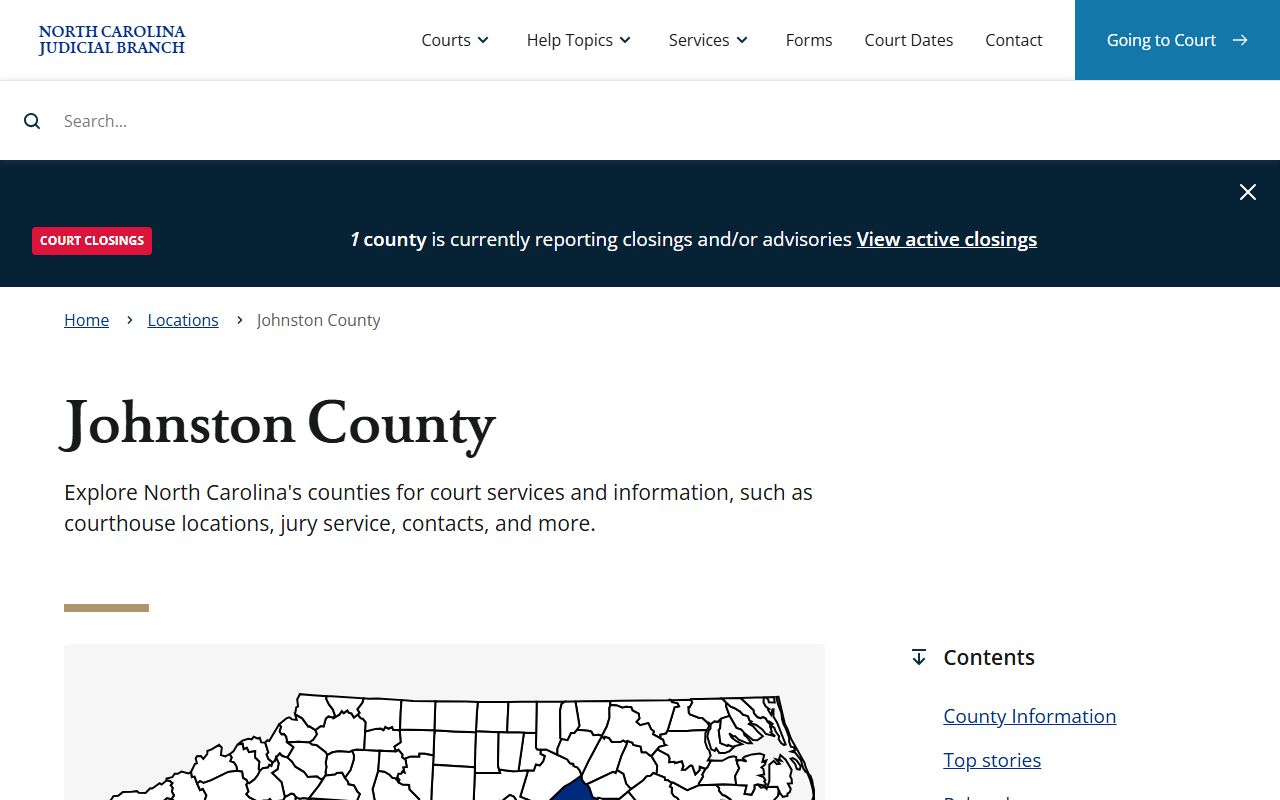
That page links straight into the portal and shows the county's Superior and District Court district numbers. Use these steps to run a basic Johnston County court records search:
- Open the eCourts Portal and choose Smart Search.
- Enter a party name, or a case number for the cleanest match.
- Open Advanced Filtering Options and set the location to Johnston County.
- Narrow by case type, filing date, or date of birth when those fields are available.
- Read the case summary, then request a certified copy from the clerk if you need one for court.
Note: a Johnston County court records search on the portal shows public docket data, but the portal is not the official record and certified copies still come from the clerk.
The Johnston County Judicial System
North Carolina runs one unified, state-operated court system called the General Court of Justice. There are no separate city or county court systems the way some states have. The Judicial Branch splits the system into three divisions: the Appellate Division, the Superior Court Division, and the District Court Division. Johnston County is listed as Prosecutorial District 13, Superior Court District 13, and District Court District 12. Every court matter in the county still flows through this one statewide structure, even though the courthouse and clerk are local.
The state's overview of how the courts are organized lays out the three divisions clearly.
You can review the divisions on the North Carolina court-structure overview.
That page is a helpful map of where each court sits. The table below shows what each level handles.
| Court | Jurisdiction | Case Types |
|---|---|---|
| Supreme Court of North Carolina | Highest state court | Final review of state-law questions |
| Court of Appeals | Intermediate appellate | Most trial-level appeals, panels of three judges |
| Superior Court | Trial court | Felonies, civil cases over $25,000, misdemeanor appeals |
| District Court | Trial court | Misdemeanors, civil $10,000-$25,000, family, juvenile, traffic |
| Magistrates | Officers of district court | Small claims under $10,000, initial appearances, warrants |
Superior Court is the higher trial court. It hears felony criminal cases and larger civil disputes, and its judges rotate among districts every six months. The court traces back to 1777. Most appeals from the trial courts go next to the Court of Appeals.
The state's Superior Court page describes that felony and high-dollar civil jurisdiction.
District Court is the busier day-to-day court. It handles misdemeanors, infractions, smaller civil suits, divorce and custody, juvenile matters, and most traffic cases. Magistrates, who are officers of the District Court, set bond, issue warrants, and hear small claims.
See the District Court page for the full list of what this division covers.
Case flow: Magistrate / District Court › Superior Court › Court of Appeals › Supreme Court of North Carolina
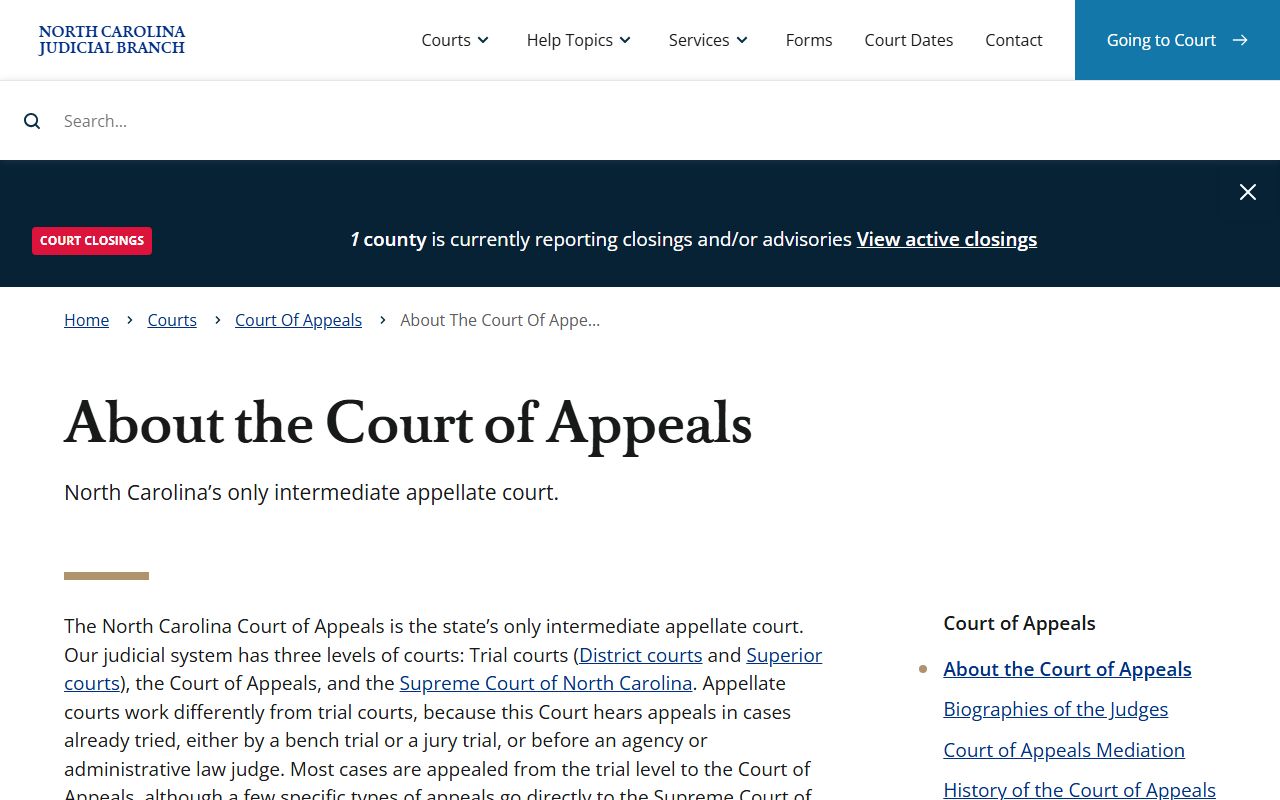
Criminal appeals from District Court are usually heard fresh, or de novo, in Superior Court. The intermediate appellate court has 15 judges who sit in panels of three.
The Court of Appeals page explains that intermediate appellate role.
For Johnston County researchers, the takeaway is simple. Start your case search at the state portal, but get official copies from the local clerk. Federal cases are separate and go through the Eastern District of North Carolina.
Types of Court Records Available in Johnston County
The Johnston County courts produce many kinds of records. Most are public, but some case types carry confidentiality rules. The eCourts Portal covers public case types, while restricted matters need elevated access or a court order. Different courts make different records, so it helps to know which division handled a matter before you search.
Here are the main record types and where they come from:
- Criminal records - felony files from Superior Court and misdemeanor and infraction files from District Court.
- Civil records - lawsuits, judgments, evictions, and money disputes split by dollar amount across the courts.
- Family and divorce records - divorce, custody, support, and protective orders handled in District Court.
- Probate and estate records - wills, estates, and guardianships kept by the Clerk of Superior Court as judge of probate.
- Traffic court records - citations and infractions paid or contested through the state courts.
The state's types-of-courts page describes which court hears which matters.
For deeper searches, the Johnston County court records page walks through the portal in detail, and the court dockets page covers hearing calendars.
What Information Is Included in Johnston County Court Records
A Johnston County court record is built from many fields. A public case summary in the portal can show the case number, the parties, the filing date, case events, hearings, dispositions, and financial details when they apply. Causes of action appear for civil, family, probate, and mental health cases. Social Security numbers should not display to any user. The table below breaks down the common fields and what each one tells you.
| Field | What It Shows |
|---|---|
| Case Number | Year, case-type letters, sequence number, and county code, such as 21CR000003-910 |
| Filing Date | When the action was opened or the citation or warrant was filed |
| Parties | Plaintiff and defendant, or the State and defendant, plus attorneys |
| Charges / Cause | The offense charged or the legal claim raised |
| Disposition | The outcome of a charge or case |
| Sentence / Judgment | The penalty, money owed, or final ruling |
Some documents are viewable online and some are not. Sealed, juvenile, and protective-order materials are held back from public view. For a complete file, you may still need to visit the clerk in the county where the case sits.
Public Access Laws for Johnston County Court Records
North Carolina treats public records as the property of the people. The state's public-records law begins in Chapter 132, and several court-specific statutes shape what you can see. Any person may inspect records and get copies, and the law says you do not have to explain why you want them. Court files held by the local clerk are different from the administrative records kept by the state court office, so a request for case files goes to the clerk, not to the state office.
Key Statutes:
North Carolina G.S. 132-1 - defines public records broadly and states they belong to the people.
North Carolina G.S. 132-6 - gives anyone the right to inspect and copy records and allows online access in view or print form.
North Carolina G.S. 132-6.2 - sets copy fees at actual cost and allows special service charges for large requests.
North Carolina G.S. 7A-109 - supports statewide indexing behind the portal's judgment and case searches.
The state's court-officials page explains the duties of clerks, district attorneys, magistrates, and judges.
That page is useful when you need to know which office actually holds a record. The clerk keeps court files; the Register of Deeds keeps land, marriage, and vital records.
Records That Are Restricted or Confidential
Not every court record is open. North Carolina law walls off several categories. Juvenile court files fall under Chapter 7B and are not ordinary public records. Adoption records are confidential. Mental health and involuntary commitment records are protected. Sealed and expunged matters drop out of public view by court order or statute. The portal also flags unreturned criminal warrants and protective orders as examples that need elevated access.
If a record was expunged, it is removed from public access, and confidential agency files behind it are governed by their own statute. To view a sealed record, a person usually must show legal standing and ask the court to unseal it. Do not assume a missing online case means no case exists. Older paper files, newly filed matters, and data-entry timing all affect what shows up in a public search.
Specialty Courts in Johnston County
North Carolina renamed its Drug Treatment Courts as Recovery Courts as the model grew to cover veterans, mental health, DWI, family, and adult treatment tracks. These are intensive, judge-supervised programs for people in the court system who face substance use or mental health issues. The goal is to cut repeat offenses and help participants stay law-abiding.
Johnston County is served by the District 11A Veterans Treatment Court, which also covers Harnett and Lee counties. It helps veterans whose court involvement ties back to trauma, mental health, or substance use, and it connects them to benefits earned through military service. The county is also part of a targeted DWI initiative. In 2025 the state announced a $147,000 Governor's Highway Safety Program grant to speed up DWI cases in Johnston, Mecklenburg, and Wake counties. That grant is not a full specialty court, but it shapes how impaired-driving cases move locally.
Johnston County Sheriff and Jail Information
The Johnston County Sheriff's Office runs the county jail and posts a public inmate list. Sheriff Steve Bizzell leads the office, which keeps its administrative address at 120 South Third Street in Smithfield. The jail itself sits nearby at 127 S. Second Street. The public active inmate inquiry shows people currently housed, their primary charge, and arrest date after you accept a disclaimer.
For the full roster walkthrough, visitation rules, and how to put money on an account, see the Johnston County inmate records page. To check for active warrants or recent bookings, the warrant records page and arrest records page cover the sheriff's recent-arrest search and what it returns.
Marriage, Divorce, and Probate Records
Two different offices hold these records. The Register of Deeds issues marriage licenses and keeps marriage records. Divorce judgments are court records held by the Clerk of Superior Court. Probate, including wills and estates, also runs through the clerk, who serves as judge of probate. See the marriage and divorce records page and the probate records page for full steps.
- Testator
- The person who made a will.
- Executor
- The person named to carry out the terms of a will.
- Intestate
- Dying without a valid will, which sets off estate administration by law.
- Guardian
- A person the court appoints to act for a minor or an incapacitated adult.
Johnston County Court Records Fees
Fees depend on what you ask for and which office holds the record. Viewing case information on the portal is free. A certified copy or a formal search carries a charge. The clerk handles certified court copies and certified criminal record searches. The Register of Deeds handles marriage licenses and recorded-document copies. The table below lists the common costs drawn from official sources.
| Item | Amount |
|---|---|
| Certified single-county criminal record search (Form AOC-CR-314) | $25.00 |
| State court office copy, per page | $0.25 |
| Record inspection | No charge |
| Marriage license | $60.00 |
The county's payment information page spells out how to pay court fines and citations.
Mail payments must be a money order or certified check payable to the Johnston County Clerk of Superior Court. In-person payments take cash, cards, money orders, or certified checks. Personal checks are not accepted.
How to Interpret Johnston County Court Records
Court files use shorthand that can trip up first-time searchers. A charge is not a conviction. A disposition is the outcome of a charge. Dismissed with prejudice means a case is closed for good; without prejudice means it can come back. A continuance just moves a court date later. The roster charge label on the jail list is a starting point, not the final filed charge.
Prosecutors can amend, dismiss, or upgrade charges as a case moves. For that reason, pair an arrest record with the court case to see what really happened. The clerk is the source for certified outcomes. If the portal and the clerk show different details, trust the clerk and keep your case number handy when you call.
Accuracy, Updates, and Record Limitations
Online records lag real life. New filings, dispositions, and payments take time to post. The Register of Deeds index, for example, is verified only through a recent date, which explains why a brand-new recording may not appear at once. Spelling variations, name changes, and sealed matters can all hide a record from a basic search.
Note: Confirm any detail that matters with the office that made the record before you rely on it, because online data can be incomplete or out of date.
History of Johnston County Courts
Johnston County was created in 1746 from Craven County and named for Gabriel Johnston, the colonial royal governor. Smithfield was chartered by the General Assembly in 1777 and remains the county seat. The courthouse has deep roots in state history. On October 18, 1775, the Provincial Council of independent North Carolina held its first meeting at the Johnston County Courthouse in Smithfield, and the General Assembly met in the town in 1779.
The modern courthouse complex fills most of a downtown block. The Superior Courtroom still hosts ceremonial county events; in December 2024 county commissioners took their oaths there before a Senior Resident Superior Court judge, with the Clerk of Superior Court helping swear them in. The county's other major historical marker, the Battle of Bentonville of March 1865, was the bloodiest battle fought on North Carolina soil.
Courthouse Location and Contact Information
The Johnston County Courthouse stands in downtown Smithfield. The Judicial Branch lists the court address as 207 E Johnston St, while the county directions page labels the building 212 E. Market Street and notes the main visitor entrance at Second and Market Streets. The complex fills the block bounded by Market, Second, Johnston, and Third Streets. An accessible ramp sits at the Second Street atrium entrance.
The official Johnston County Courthouse page lists the address, hours, and wheelchair-entrance details.
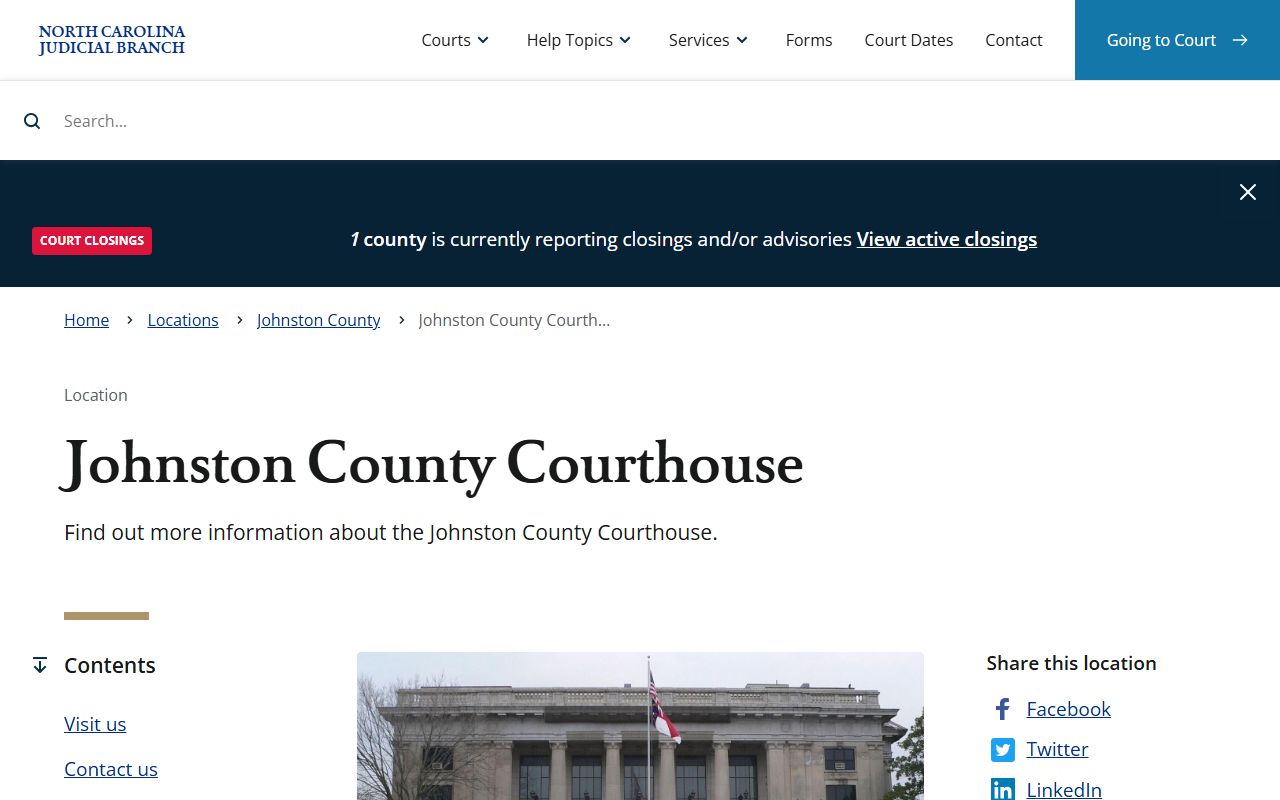
Use the contact card below for the clerk's office, and call ahead to confirm hours before a visit.
Johnston County Clerk of Superior Court
Johnston County Courthouse
207 E Johnston St (PO Box 297)
Smithfield, NC 27577
(919) 209-5400
Monday-Friday, 8:00 AM-5:00 PM
The court's contact directory lists phone numbers for the clerk, judges, the district attorney, and magistrates.
That directory is the quickest way to reach the right division for your matter.
Where do I get a certified copy of a Johnston County court record?
Certified copies come from the Clerk of Superior Court in the county where the case was filed. For Johnston County matters, contact the clerk at (919) 209-5400 or visit the courthouse. The portal can print public docket information for free, but those printouts are not certified and may not be accepted in court.
Is the Clerk of Superior Court the same as the Register of Deeds?
No. The clerk keeps court case files and serves as judge of probate. The Register of Deeds keeps deeds, plats, marriage records, and birth and death records. Court cases go to the clerk; marriage licenses and land records go to the Register of Deeds.
Self-Help and Legal Aid Resources in Johnston County
Court staff cannot give legal advice or fill out forms for you. They can hand you forms and explain procedure. For guided help, North Carolina offers Guide & File, a free online tool that prepares documents for case types like Absolute Divorce, Small Claims, Summary Ejectment, and Petition to Proceed as an Indigent.
For free civil legal help, Legal Aid of North Carolina runs clinics on expunction, housing, and family matters where eligible. The North Carolina Bar Association also runs a lawyer referral service. Johnston County has its own Public Defender office, established in 2024, to represent eligible people who cannot afford counsel in qualifying cases. For criminal charges, warrants, or expunction questions, talk to an attorney before you act.
Frequently Asked Questions
How do I search Johnston County court records online?
Use the North Carolina eCourts Portal. Choose Smart Search for case details, Search Hearings for court dates, and NC Judgment Search for judgment indexes. Set the location to Johnston County. For official certified copies, contact the Clerk of Superior Court at (919) 209-5400.
Is the portal the official court record?
No. The state says the portal is not the official court record. It gives internet access to public docket entries and case information. If you need a certified copy or a file that is not fully online, contact the clerk in the county where the case was filed.
How do I find someone in the Johnston County Jail?
Start at the Sheriff's Office active inmate inquiry, accept the disclaimer, and view the list of people currently housed. The list shows name, primary charge, and arrest date. For more, call the jail at 919-989-5040. The inmate records page covers the full process.
More answers are on the Johnston County court records FAQ page.